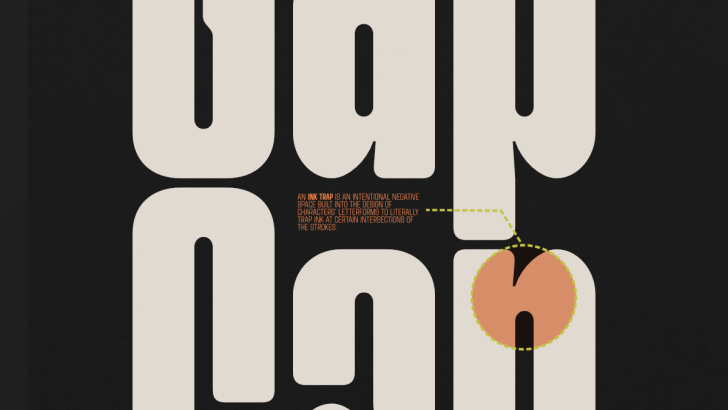
Ink trap is a typographic design technique that was originally created for technical purposes rather than aesthetics. The term refers to small notches or cut-ins placed at the inner corners of letterforms, typically where strokes meet, such as in the letters “n,” “m,” or “a.” At larger sizes, ink traps appear as visible cuts, but when printed at small sizes, they help the letters look cleaner and sharper.
Historically, ink traps emerged due to limitations in printing technology, especially in older printing methods where excess ink could spread on paper. This ink spread often caused inner corners of letters to become too heavy or blurred, reducing legibility. By adding ink traps, designers created extra space that would be filled by the spreading ink, allowing the final printed letterforms to maintain their intended shape and clarity.
With the advancement of digital technology, the technical necessity of ink traps has decreased. However, many modern designers have embraced ink traps as a distinctive visual feature. When used at larger display sizes, they create a sharp, futuristic, and sometimes experimental look, making them popular in branding, posters, and contemporary display fonts.
Today, ink traps serve not only as a functional solution but also as a stylistic choice. Some typefaces use subtle ink traps to maintain readability, while others exaggerate them to establish a strong visual identity. When applied thoughtfully, ink traps offer a compelling balance between function and aesthetics in modern typography.
one of the fonts that uses the inktrap technique:
